Rep. Melissa Bean (D) has a big lead over wealthy investment banker David McSweeney (R), according to a new Democratic poll obtained by Roll Call.The Benenson Strategy Group survey was done for the Democratic Congressional Campaign Committee and paid for by an independent expenditure. It surveyed 400 likely voters and had a 5 percent margin of error.
Bean led McSweeney, who spent more than $2.4 million to win the GOP primary in March, by a 47 percent to 28 percent margin.
The survey also showed that 30 percent of respondents think the country is on the right track, while 60 percent said it is on the wrong track.
President Bush, who won 56 percent of the vote in the suburban Chicago district in 2004, had a 40 percent favorable/53 percent unfavorable rating, according to the poll.
Wednesday, September 13, 2006
Good News From View Outside My Office Window


Ann Richards, 1933 - 2006

Thanks Ann.
"Poor George, he can't help it. He was born with a silver foot in his mouth."
Just Don't Leave Me With Classic Rock

I drive 22,000 miles per year. 90% of that time I spend with Air America. When I'm in the office Air America is on 98% of the time. And, quite frankly, I really like the Jerry Springer (Radio) show.
From ThinkProgress:
EXCLUSIVE: Air America To Declare Bankruptcy, But Progressive Radio Remains Strong
Air America Radio will announce a major restructuring on Friday, which is expected to include a bankruptcy filing, three independent sources have told ThinkProgress.Air America could remain on the air under the deal, but significant personnel changes are already in the works. Sources say five Air America employees were laid off yesterday and were told there would be no severance without capital infusion or bankruptcy. Also, Air America has ended its relationship with host Jerry Springer.
The right wing is sure to seize on Air America's financial woes as a sign that progressive talk radio is unpopular. In fact, Air America succeeded at creating something that didn't exist: the progressive talk radio format. That format is now established and strong and will continue with or without Air America. Indeed, many of the country's most successful and widely-syndicated progressive talk hosts, Ed Schultz and Stephanie Miller, for instance, aren't even associated with Air America.
Radio giant Clear Channel is so committed to progressive talk radio that, this week, it will announce a partnership with the Center for American Progress and MSS Inc. to conduct a nationwide search for the next Progressive Talk Radio Star.
UPDATE: Air America responds.
If Air America had filed for bankruptcy every time someone rumored it to be doing so, we would have ceased to exist long ago; it may be frustrating to some that this hasn’t happened. No decision has been taken to make any filing of any kind, we are not sure of the source of these rumors and frankly can not respond to every rumor in the marketplace.
6.3% Better Than All Of The U.S.
Tuesday, September 12, 2006
It Ain't The God...

...It's the power.
This opening comment from a regular contributor to the blog Christian Conservative on the occasion of the fifth anniversary of 9/11:
May God continue to Bless the United States of America, and curse our enemies.
The Question of The Week
If the war on terror is really a "struggle for civilization" itself, as President Bush claimed last night, why do we have just 130,000 troops in Iraq?
You would think that if America were really engaged in such an epic battle -- "for all the marbles," as one friend paraphrased it -- we would put up a bigger fight.
You Can't Read This Either
Osama’s Spin Lessons
By JOHN TIERNEYSomewhere, Osama bin Laden must be smiling. Or at least he will be whenever his couriers deliver the next batch of press clippings.
Once again he has beaten America at an American game: public relations. He may be sitting powerlessly in a cave, but his image is as scary as ever. He doesn’t even have to cut a new video. He released an old one last week, the equivalent of a fading musician putting out a greatest-hits album, only this one’s getting played every hour.
Last night, President Bush paid him homage by quoting his warning that America will face “defeat and disgrace forever” it if loses in Iraq. Bush himself called the war on terror a “struggle for civilization,” and said it was essential to ”maintain the way of life enjoyed by free nations.”It was just the kind of apocalyptic language favored by bin Laden, except that, for all his delusions, he might realize that American civilization is not really in jeopardy. Americans can try to copy him, but they don’t understand his rhetorical technique.
They continually misinterpret his equine theory of international relations: “When people see a strong horse and a weak horse, by nature, they will like the strong horse.” This is supposedly a reason America was attacked on Sept. 11 — it was perceived as weak for failing to respond to Al Qaeda’s earlier attacks — and why it can’t leave Iraq.
If we falter in Iraq, Vice President Dick Cheney explained to Tim Russert on Sunday, the war on terror will falter because people will say: “My gosh, the United States hasn’t got the stomach for the fight. Bin Laden’s right, Al Qaeda’s right, the United States has lost its will and will not complete the mission.”
But bin Laden knows something else the Bush administration hasn’t figured out: You don’t actually have to be the strong horse. You just have to look stronger. You can be weak, you can be pummeled in a fight, but as long as your opponent looks more scared than you, you can save face by simply declaring victory.
As an act of war, the attack on Sept. 11 was a blunder by Al Qaeda, and not merely because of the counterattack that destroyed Al Qaeda’s training camps and ousted the Taliban. It also alienated former jihadist allies in the Arab world, and caused a rift within Al Qaeda.
One of its senior members, Abu al-Walid al-Masri, broke with bin Laden and accused him of having an “extreme infatuation” with international publicity. The attack, as Fawaz Gerges notes in Foreign Policy magazine, demonstrated that “bin Laden was prepared to sacrifice Afghanistan and Mullah Omar at the altar of his public relations campaign.”
But at least bin Laden knew his P.R. Al Qaeda wasn’t a serious military threat to America, but it could play one on television. As Al Qaeda’s losses mounted and America recovered from the attack, bin Laden and his cohorts didn’t let the facts get in the way of their campaign to promote fear (and themselves). They hid in caves and proclaimed themselves champions.
America, meanwhile, accentuated the negative. Instead of declaring victory against terrorists after routing the Taliban and sending bin Laden into hiding, it invaded Iraq, reinvigorating Al Qaeda with a new tool for recruiting. Instead of putting the terrorist risk in perspective, Bush (with the full cooperation of Democrats and the press) set an impossible standard for making America safe.
“We’re on the offense against the terrorists on every battlefront,” Bush said last week, “and we’ll accept nothing less than complete victory.”
When you define victory that way, when you treat one attack from a disorganized band of fanatics as a menace to civilization, you’ve doomed yourself to defeat and caused more damage than they could. You can’t completely stop terrorism, but you can scare people into giving up liberties, wasting huge sums of money and sacrificing more lives than would be lost in a terrorist attack.
Take it from bin Laden, who bragged in 2004 that it was “easy to provoke and bait this administration.”
“All that we have to do,” he said, “is to send two mujahedeen to the farthest point east to raise a piece of cloth on which is written Al Qaeda, in order to make the generals race there to cause America to suffer human, economic and political losses.” And then Al Qaeda, no matter what losses it has suffered, will come off once again looking like the strong horse.
Sunday, September 10, 2006
No One Mourns The Wicked
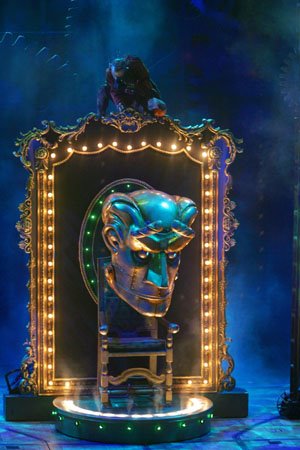
Oh you know how Sundays are. A time to try to address all the to-do lists of your personal life.
Work after vacation is always characterized by 'catch-up'. Posts have been less frequent this week than the previous one when I wasn't even at a real computer. And I have begun to look forward to September's social responsibilities, like GT12 semi-annual Social Distortion show (9/29/06) and our family's visit in two weeks to see 'Wicked'.
So, imagine my amusement to find a post from one of the sites already linked (below) that brings together Wicked and The War on Terror.
Johann Hari notes the London opening of Wicked this week:
[the show begins to give] flashbacks to [The Wicked Witch of The West's] childhood. As she waded through the insults (it ain’t easy being green) and bullies, [TWWotW]gradually realised that Oz was not the Paradise its citizens endlessly, brainlessly chant about.
No – it is a Technicolor tyranny. The Wizard is a dictator, who turns the people against Elphaba because "the way to bring people together is to give them a really terrible enemy.”. She was, in reality, a freedom fighter trying to rescue the people of Oz, turned into an Emanuel Goldstein for the Yellow Brick Road. Confronted with his crimes, the Wizard insists: "[You can call me] a traitor or liberator/ Is one a crusader or ruthless invader?/ It's all in which label is able to persist." It’s not a great musical – the tunes are pretty forgettable – but just go and savour the bleak political resonance.


GT12 Prints Things That You Can't Read
This is the question I've been asking for 4 1/2 years.
Whatever Happened to the America of 9/12?“THE most famous picture nobody’s ever seen” is how the Associated Press photographer Richard Drew has referred to his photo of an unidentified World Trade Center victim hurtling to his death on 9/11. It appeared in some newspapers, including this one, on 9/12 but was soon shelved. “In the most photographed and videotaped day in the history of the world,” Tom Junod later wrote in Esquire, “the images of people jumping were the only images that became, by consensus, taboo.”
Five years later, Mr. Drew’s “falling man” remains a horrific artifact of the day that was supposed to change everything and did not. But there’s another taboo 9/11 photo, about life rather than death, that is equally shocking in its way, so much so that Thomas Hoepker of Magnum Photos kept it under wraps for four years. Mr. Hoepker’s picture can now be found in David Friend’s compelling new 9/11 book, “Watching the World Change,” or on the book’s Web site, watchingtheworldchange.com. It shows five young friends on the waterfront in Brooklyn, taking what seems to be a lunch or bike-riding break, enjoying the radiant late-summer sun and chatting away as cascades of smoke engulf Lower Manhattan in the background.
Mr. Hoepker found his subjects troubling. “They were totally relaxed like any normal afternoon,” he told Mr. Friend. “It’s possible they lost people and cared, but they were not stirred by it.” The photographer withheld the picture from publication because “we didn’t need to see that, then.” He feared “it would stir the wrong emotions.” But “over time, with perspective,” he discovered, “it grew in importance.”
Seen from the perspective of 9/11’s fifth anniversary, Mr. Hoepker’s photo is prescient as well as important — a snapshot of history soon to come. What he caught was this: Traumatic as the attack on America was, 9/11 would recede quickly for many. This is a country that likes to move on, and fast. The young people in Mr. Hoepker’s photo aren’t necessarily callous. They’re just American. In the five years since the attacks, the ability of Americans to dust themselves off and keep going explains both what’s gone right and what’s gone wrong on our path to the divided and dispirited state the nation finds itself in today.What’s gone right: the terrorists failed to break America’s back. The “new” normal lasted about 10 minutes, except at airport check-ins. The economy, for all its dips and inequities and runaway debt, was not destroyed. The culture, for better and worse, survived intact. It took only four days for television networks to restore commercials to grim news programming. Some two weeks after that Rudy Giuliani ritualistically welcomed laughter back to American living rooms by giving his on-camera imprimatur to “Saturday Night Live.” Before 9/11, Americans feasted on reality programs, nonstop coverage of child abductions and sex scandals. Five years later, they still do. The day that changed everything didn’t make Americans change the channel, unless it was from “Fear Factor” to “American Idol” or from Pamela Anderson to Paris Hilton.
For those directly affected by the terrorists’ attacks, this resilience can be hard to accept. In New York, far more than elsewhere, a political correctness about 9/11 is still strictly enforced. We bridle when the mayor of New Orleans calls ground zero “a hole in the ground” (even though, sadly, he spoke the truth). We complain that Hollywood movies about 9/11 are “too soon,” even as “United 93” and “World Trade Center” came and went with no controversy at multiplexes in middle America. The Freedom Tower and (now kaput) International Freedom Center generated so much political rancor that in New York freedom has become just another word for a lofty architectural project soon to be scrapped.
The price of all New York’s 9/11 P.C. is obvious: the 16 acres of ground zero are about the only ones that have missed out on the city’s roaring post-attack comeback. But the rest of the country is less invested. For tourists — and maybe for natives, too — the hole in the ground is a more pungent memorial than any grandiose official edifice. You can still see the naked wound where it has not healed and remember (sort of) what the savage attack was about.
But even as we celebrate this resilience, it too comes at a price. The companion American trait to resilience is forgetfulness. What we’ve forgotten too quickly is the outpouring of affection and unity that swelled against all odds in the wake of Al Qaeda’s act of mass murder. If you were in New York then, you saw it in the streets, and not just at ground zero, where countless thousands of good Samaritans joined the official responders and caregivers to help, at the cost of their own health. You saw it as New Yorkers of every kind gathered around the spontaneous shrines to the fallen and the missing at police and fire stations, at churches and in parks, to lend solace or a hand. This good feeling quickly spread to Capitol Hill, to red states where New York had once been Sodom incarnate and to the world, the third world included, where America was a nearly uniform object of sympathy and grief.
At the National Cathedral prayer service on Sept. 14, 2001, President Bush found just the apt phrase to describe this phenomenon: “Today we feel what Franklin Roosevelt called ‘the warm courage of national unity.’ This is the unity of every faith and every background. It has joined together political parties in both houses of Congress.” What’s more, he added, “this unity against terror is now extending across the world.”
The destruction of that unity, both in this nation and in the world, is as much a cause for mourning on the fifth anniversary as the attack itself. As we can’t forget the dead of 9/11, we can’t forget how the only good thing that came out of that horror, that unity, was smothered in its cradle.
When F.D.R. used the phrase “the warm courage of national unity,” it was at his first inaugural, in 1933, as the country reeled from the Great Depression. It is deeply moving to read that speech today. In its most famous line, Roosevelt asserted his “firm belief that the only thing we have to fear is fear itself — nameless, unreasoning, unjustified terror which paralyzes needed efforts to convert retreat into advance.” Another passage is worth recalling, too: “We now realize as we have never realized before our interdependence on each other; that we cannot merely take but we must give as well; that if we are to go forward, we must move as a trained and loyal army willing to sacrifice for the good of a common discipline, because without such discipline no progress is made, no leadership becomes effective.”
What followed under Roosevelt’s leadership is one of history’s most salutary stories. Americans responded to his twin entreaties — to renounce fear and to sacrifice for the common good — with a force that turned back economic calamity and ultimately an axis of brutal enemies abroad. What followed Mr. Bush’s speech at the National Cathedral, we know all too well, is another story.
On the very next day after that convocation, Mr. Bush was asked at a press conference “how much of a sacrifice” ordinary Americans would “be expected to make in their daily lives, in their daily routines.” His answer: “Our hope, of course, is that they make no sacrifice whatsoever.” He, too, wanted to move on — to “see life return to normal in America,” as he put it — but toward partisan goals stealthily tailored to his political allies rather than the nearly 90 percent of the country that, according to polls, was rallying around him.
This selfish agenda was there from the very start. As we now know from many firsthand accounts, a cadre from Mr. Bush’s war cabinet was already busily hyping nonexistent links between Iraq and the Qaeda attacks. The presidential press secretary, Ari Fleischer, condemned Bill Maher’s irreverent comic response to 9/11 by reminding “all Americans that they need to watch what they say, watch what they do.” Fear itself — the fear that “paralyzes needed efforts to convert retreat into advance,” as F.D.R. had it — was already being wielded as a weapon against Americans by their own government.
Less than a month after 9/11, the president was making good on his promise of “no sacrifice whatsoever.” Speaking in Washington about how it was “the time to be wise” and “the time to act,” he declared, “We need for there to be more tax cuts.” Before long the G.O.P. would be selling 9/11 photos of the president on Air Force One to campaign donors and the White House would be featuring flag-draped remains of the 9/11 dead in political ads.
And so here we are five years later. Fearmongering remains unceasing. So do tax cuts. So does the war against a country that did not attack us on 9/11. We have moved on, but no one can argue that we have moved ahead.
Stop The War!
Johann Hari examines another of the countless incidents of collateral damage done by the War On Drugs.
Key Quote:
Over the past five years, with British and American military support, a sinister corporation called DynCorps has been going to the fields of the poorest farmers in Afghanistan and systematically destroying them. This is because they are growing opium poppies, used to make heroin that is freely bought on the streets of the West. Emmanuel Reinert, the Executive Director of the Senlis Council, explains, “The Taliban revival is directly, intimately related to the crop eradication programme. It could not have happened if the US was not aggressively destroying crops. It is the single biggest reason Afghans turned against the foreigners.”
Thursday, September 07, 2006
Let's See Action
Then follow these instructions from AmericaBlog:
Action Alert: Ask Disney Chairman George Mitchell to pull the partisan 9/11 show
From ThinkProgress:
Over 50,000 ThinkProgress readers have written ABC in the last 48 hours about “The Path to 9/11.” We’re going to keep the pressure on ABC, but we’re also broadening our focus today to the Walt Disney Company, which owns ABC.Disney’s Chairman of the Board is former Senate Majority Leader George Mitchell (D-ME). Senator Mitchell has a long and distinguished career both inside and outside government and he knows how important it is to accurately represent historical events.We need to remind him that 9/11 was a national tragedy, and that politicizing and flagrantly misrepresenting the facts about 9/11 is wrong.
Senator George J. Mitchell
T: (212) 335-4600
T: (212) 335-4500
F: (212) 335-4605
george.mitchell@dlapiper.com (Remember to be polite, and please copy tellabc@americanprogressaction.org so they can keep track your comments.)

Christgau Fired!

The Village Voice (recently purchased by, however oxymoronic it may sound, an alternative press media corp) has fired one of, if not the, greatest influence on GT12's approach to writing and most importantly toward Music (our life blood). He is the best. If he doesn't like it, and you do, the reasons are clear and thought-provoking. We say this even though RC holds a ridiculous aversion to Little Steven's voice. His record guides are bibles.
RC Confirms the reports:
2006-09-05: Reports of My Dismissal Have Been Reasonably Accurate
On August 31, I was terminated by the new owners of The Village Voice along with four other senior editors, two gifted designers, and half of the two-person photo department. The mass layoff was characterized as a "restructuring," but I was fired "for taste." Because our union long ago anticipated the possibility of this kind of drastic overhaul, a contractually mandated severance arrangement will give me some time to get my economic future in order. But the specifics of that future probably won't be clear for a while.
The Voice changed a lot over the 37 years I wrote there and 32 years I was employed there. I haven't approved of all those changes, especially over the past decade. But for most of that time, with our unionization when Rupert Murdoch purchased the paper in 1977 a turning point, the Voice paid me to write well. My old bosses always understood that constructing a well-informed essay takes time, and that sorting, grading, and saying something honest and original about an incomprehensible plethora of records takes forever. I am grateful for the support my editors gave me, although I certainly believe I gave them surplus value back. But how my worklife is to proceed remains to be seen. I'll be letting you know in this space when I know myself.
Let me take this opportunity to say how very grateful I am, first simply for the interest all the visitors to this site have taken in my work, but especially for the labor volunteered by a few. Tom Hull's contribution is of course inestimable. The condolence notes Tom has forwarded to me have been much appreciated. I'll be OK. Like they say, it's too late to stop now. Or was that can't stop won't stop? Either way, both ways, I'll be in touch, and I'll be listening.
Wednesday, September 06, 2006
Don't Confuse Me With Facts
They know what they want to know
From the "God Help Us All" Department, John Zogby delivers this dreary bit of polling news: Even though George W. Bush has finally acknowledged that Iraq had "nothing" to do with 9/11, 46 percent of Americans still believe that there was "a connection" between Saddam Hussein and the attacks.
It gets worse. Only 50 percent say there was no connection, meaning you can add 4 percent who don't know one way or another to the 46 percent who "know" something that's pretty much undisputedly false. Among Republicans, the numbers are even more depressing: Sixty-five percent of them say there was a connection between Saddam and 9/11. "Only" 32 percent of Democrats and 39 percent of independents share that view.
The good news? In a Washington Post poll taken in September 2003, 69 percent of Americans said that Saddam Hussein was involved in planning 9/11. Three years and about 2,400 dead soldiers later, it seems that at least some of our children is learning.